3,650 commits, 1,400 merged pull requests, and 647 contributors later, Hermes ships real-time voice you can interrupt, citations you can verify, and agents that talk to each other
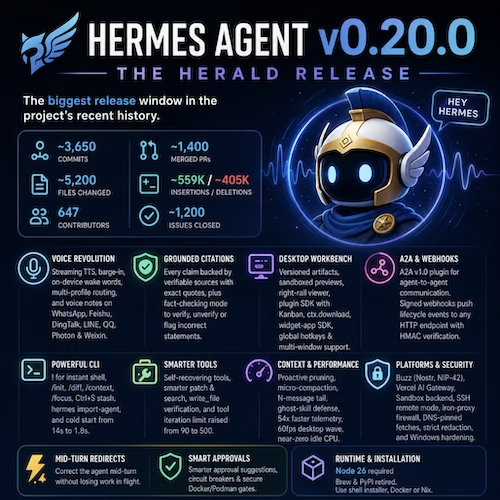
Hermes Agent v0.20.0, codenamed The Herald Release, shipped on August 3, 2026, as tag v2026.8.3. The numbers alone tell you this is no routine update. Roughly 3,650 commits, 1,400 merged pull requests, 5,200 changed files, 559,000 insertions, 405,000 deletions, and 1,200 closed issues, with contributions from 647 people.
That makes it the largest update since v0.19.0. It touches voice, research, the desktop app, multi-agent work, the CLI, internals, platforms, and security. Here is what changed, and what deserves your attention first.
Voice that speaks clause by clause, and lets you cut in
The centerpiece of the release is a complete overhaul of voice interaction. Streaming conversational TTS with barge-in means Hermes now speaks clause-by-clause as the response generates, instead of making you wait for a finished block of text.
If you start talking mid-sentence, Hermes stops, and the model is notified of the interruption, so it knows why its thought got cut short. Busy-aware silence detection keeps it from jumping in when you are simply pausing.
Wake words now run fully on-device and accept open-vocabulary phrases. Say “hey Hermes” or pick any custom phrase you like, and no audio leaves your machine while it waits.
Routing got smarter as well. Multi-profile voice routing sends different wake words to different profiles, and saying “stop” ends voice chat hands-free on every surface.
Voice notes now work on WhatsApp, Feishu, DingTalk, LINE, QQ, Photon, and Weixin, with platform-aware auto-TTS delivery. Speech-to-text gains its own configurable hermes tools category, GUI toggles, and OpenAI gpt-transcribe support.
Citations you can verify, claims you can check
The new grounded-citations skill attacks a familiar problem: confident answers built on shaky sources. It requires every claim to cite a verifiable source, matches quotes against actual page text, and links each citation to the exact evidence behind it. Instead of trusting a summary, you can trace a statement back to the page that supports it.
The same rigor applies to anything you hand the agent. A fact-checking mode reviews user-supplied documents or claims and separates verified, unverified, and incorrect assertions, so you know where a statement stands before you repeat it. If Hermes does research for you, this is the feature that changes how much you can trust the output.
The desktop grows from chat client into workbench
The desktop app has evolved from a chat client into a workbench. Artifacts render as versioned cards with a sandboxed live preview in a right-rail viewer, so you can inspect what the agent built without leaving the session. Outputs stop being text you copy elsewhere, and start being things you can act on in place.
A plugin SDK launched alongside it, with Kanban as the first plugin. Developers also get ctx.download for file handoffs and a widget-app SDK for building their own surfaces.
Two quality-of-life additions round it out. A global-hotkey quick-entry window captures thoughts into any session from anywhere in the OS, and the app now supports multiple GUI windows with floating pane placement.
Agent-to-agent protocol, and events that push themselves
A2A v1.0 arrived as a bundled plugin, closing issue #514. Hermes can now discover, communicate with, and be driven by other A2A-compatible agents, which gives multi-agent systems a standard wire protocol instead of bespoke glue code.
For the rest of your stack, outbound webhooks push signed lifecycle events to any HTTP endpoint. Session activity, turn completions, and tool events arrive verified with HMAC signatures. That eliminates polling loops for CI pipelines, dashboards, and home-automation integrations. Your other systems stop asking whether Hermes did the work. Hermes tells them.
A faster CLI, smarter tools, and a lighter context window
Terminal users got a power-user wave. The ! prefix runs shell commands instantly without consuming a model turn, while /init scans a project and generates or updates an AGENTS.md. /diff, /context, and /focus expose staged changes, context-window contents, and reduced-output views. Ctrl+S stashes half-written prompts, and hermes import-agent migrates Claude Code or Codex CLI setups in one command. Cold start for hermes -w dropped from 14 seconds to 1.8 seconds.
Tools also recover from their own stumbles now. Truncated terminal output spills to a readable file, patch detects already-applied edits and whitespace mismatches, write_file verifies disk content, and empty searches probe near-misses. The default tool-calling iteration limit rose from 90 to 500.
Context compression was reworked with proactive tool-result pruning, per-turn micro-compaction, a guaranteed N-user-messages tail, progress-aware timeouts, and ghost-skill defense, so pruned skills cannot silently influence sessions. Thresholds are configurable per-model and in absolute tokens.
Performance follows. Anthropic tool-schema prompt caching lands without history loss, config telemetry reads are 54x faster after eliminating deep copies, and a desktop 60fps wave makes streaming cost independent of transcript length, with idle CPU near zero in the background. About 770 bug-fix PRs cover full-duplex voice interruption, desktop queue management, session scoping, and context-length fallbacks.
New platforms, hardened security, and three things to try first
Platform support widens with Buzz, Block’s Nostr-based messenger, which connects through a native WebSocket transport with NIP-42 authentication. The Vercel AI Gateway provider and the Sandbox terminal backend return modernized. Desktop gains an SSH remote-backend mode, and Relay ships media, interactive prompts, thread lifecycle, typing indicators, plus HSP personal and organizational skill sync.
Security got tighter at the same time. An iron-proxy credential-injection egress firewall, DNS-pinned SSRF-safe fetches, and strict redaction at compaction boundaries harden the defaults. A Windows hardening wave closed the text-mode subprocess decode bug class repo-wide. One breaking note: runtime requirements now specify Node 26, and brew plus pip/PyPI wheel channels were retired in favor of the shell installer, Docker, and Nix.
Where does that leave you? If Hermes touches your research, automation, or multi-agent workflows, these upgrades are immediately actionable. Start with three concrete steps: enable voice mode, test the grounded-citations skill, and wire a signed outbound webhook to a dashboard. The Herald Release is huge, but the entry points are small.
Do you want to run Hermes Agent on your own VPS? CLICK HERE!