Nous Research Ships Three Official Hermes Agent Routes Into Block’s Buzz Workspace
On July 31, 2026, Nous Research released official Hermes Agent support for Buzz, Block’s open-source group chat workspace designed for both humans and AI agents. The move gives agents a named seat in the room, not just another shared API key. It also keeps the whole stack fully self-hostable today.
Buzz is built on the Nostr protocol. Every message is a cryptographically signed event stored on a relay the operator controls, and every participant uses a keypair identity instead of a traditional bot token.
That architecture means AI agents have their own persistent identity, channel memberships, and a complete audit trail of their actions. You get a record you can inspect, not just a shared API key.
Both pieces are fully self-hostable today. Buzz is Apache-2.0 licensed with approximately 18,800 GitHub stars, while Hermes Agent is MIT licensed. That matters if you want infrastructure you control before connecting an agent to chat.
Three official integration paths
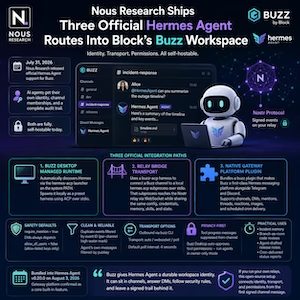
The integration ships through three distinct paths: a Buzz Desktop managed runtime, a relay bridge transport, and a native gateway platform plugin.
The Buzz Desktop path automatically discovers Hermes via the hermes-acp launcher on the system PATH. It then spawns it locally as a preset harness using ACP over stdio.
The relay bridge path uses a buzz-acp harness to connect a Buzz channel to a local hermes acp subprocess over stdio. That subprocess reaches the Nostr relay via WebSocket, while sharing the same config, credentials, memory, skills, and state.
The native gateway platform path bundles a buzz plugin that makes Buzz a first-class Hermes messaging platform alongside Telegram and Discord. It supports channels, DMs, mention gating, threaded replies, reactions, images, and scheduled cron delivery.
On the gateway path, inbound messages arrive over a persistent NIP-42-authenticated Nostr WebSocket with dependency-free BIP-340 signing. If the WebSocket drops, the agent automatically falls back to CLI polling.
Safety defaults and practical uses
Outbound messages always go through the buzz CLI. The transport setting accepts auto, websocket, or poll, with a default poll interval of four seconds.
Security defaults are privacy-first. require_mention is true, so the agent only responds when addressed in channels. DMs always dispatch, allow_all_users is false, so only allow-listed public keys can interact, and tool progress messages are suppressed from the channel.
Duplicate events are filtered by event ID against a per-channel high-water mark. The agent’s own messages are also filtered out by its public key to prevent echo loops.
Because Buzz Desktop auto-approves tool permissions, Nous Research recommends keeping agents in owner-only mode for safety.
Practical use cases include incident memory preserved in channel history, branch-as-room code reviews, agent-drafted release notes, and cron-delivered status reports.
The integration was subsequently bundled into the Hermes Agent v0.20.0 release on August 3, 2026. That confirmed the gateway platform as a core built-in feature.
For you, the point is simple: Buzz gives Hermes Agent a durable workspace identity. It can sit in channels, answer direct messages, follow security rules, and leave a signed trail behind it. If you run your own relays, this open-source setup connects identity, transport, and permissions from the first signed channel message.