Nous Research’s 5,800-commit release gives agents names, memories, schedules, and each other, pushing Hermes past the chat interface and toward an operating system for autonomous work
Most AI assistants still work like one employee juggling too many tabs. On August 31, 2026, Nous Research shipped something different: Hermes Agent v0.21.0, codenamed “The Pantheon Release.”
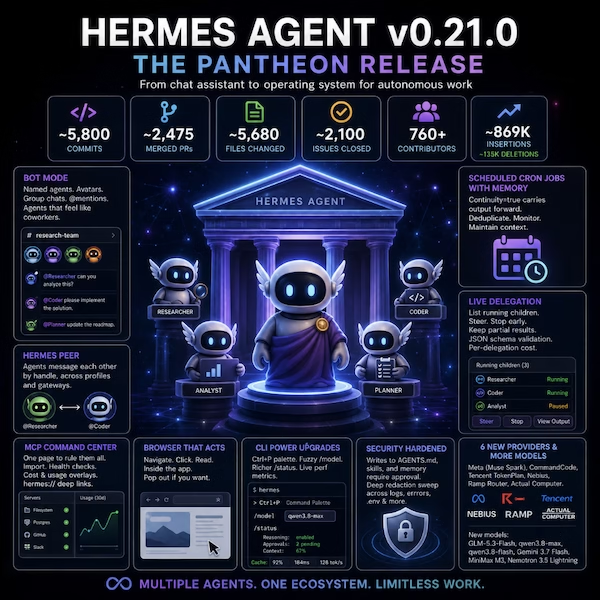
The scale says this is not a routine update: roughly 5,800 commits, 2,475 merged pull requests, 5,680 changed files, and 2,100 closed issues, contributed by over 760 people. Here is what changed, and why it matters to you.
Bot Mode gives every agent a name, a face, and coworkers
Bot Mode is now built into the desktop app by default. Every agent profile gets a name, a deterministic avatar face, and a place in a shared roster.
You can open Discord-style group chats where multiple bots and the human operator talk in one room, with @-mention support and named rooms with profile pictures.
Then it goes further. With hermes peer, any Hermes agent can message any other by handle, across profiles and gateways, from the CLI or inside a conversation.
Picture a research bot handing its findings to a coding bot. The reply comes back in a durable thread, not as a fire-and-forget call. Agents start to feel less like tools you summon and more like teammates you message.
Cron jobs that remember and delegation you can steer
Scheduled cron jobs gained memory and continuity. Cron agents now load and update persistent memory just like interactive agents.
With continuity=true, each run’s output carries into the next, so a monitor can deduplicate against what it already reported. Cron output can also land in a bot’s canonical chat, where the scheduled job actually responds and maintains context.
delegate_task gained live orchestration mid-flight. You can list running child agents, steer one with a course correction, or stop it early and keep the partial result.
Add optional JSON-schema validation on child outputs and per-delegation cost surfacing, and the feature moves from fire-and-pray to managed parallel work.
One page for MCP, a browser that acts, and a faster CLI
MCP server management merged into a single desktop page, the “MCP command center.” Drag-in import, background health checks, and fleet cost and usage overlays show schema token estimates and 30-day usage per server.
hermes:// deep links make server installs a one-click affair.
The in-app browser is no longer view-only: Hermes can navigate, click, and read pages directly inside the desktop app, and pages can be popped out to the system browser.
The CLI received a power wave too. Ctrl+P opens a fuzzy command palette, the /model picker filters as you type, /status shows reasoning mode, pending approvals, and context usage, and the status bar displays live cache-hit percentage, latency, and tokens per second.
Hardened security, six new providers, and the road here
Security hardening starts with protected instruction files. Writes to AGENTS.md, skills, and memory stores now always require approval, which stops prompt-injected agents from quietly rewriting their own standing orders.
A deep redaction sweep also closed secret-leak gaps across terminal errors, .env reads, checkpoints, and logs.
Six new providers arrived: Meta Model API (Muse Spark) as a built-in provider, CommandCode, Tencent TokenPlan, Nebius Token Factory, Ramp Router, and Actual Computer. The model catalog added GLM-5.3-Flash, qwen3.8-max/flash, Gemini 3.7 Flash, MiniMax M3, and Nemotron 3.5 Lightning.
With model_overrides, you can patch any model’s context window, pricing, or capabilities in config without waiting for a release. And data-training-tier warnings now guard every model picker surface when a provider trains on user data.
The release also rolls up and documents the v0.20.1 through v0.20.6 patch windows from August 13–27, previously released as tags without full notes per the team’s rollup policy.
The takeaway: closer to an OS than a chat interface
Taken together, v0.21.0 changes what Hermes Agent is. It is no longer a single assistant that runs tools. It is a platform where multiple agents coexist, communicate, schedule themselves, and share memory, closer to an operating system for autonomous work than a chat interface. If you have been waiting for agents that behave like coworkers, the Pantheon Release is your invitation to look.
Do you want to learn more about Hermes Agent and how to host it? CLICK HERE