The Quicksilver Release introduces 0.9-second cold starts, live reasoning streams, smart approvals, crash recovery, improved secret management, and support for the latest AI models—making Hermes Agent faster, safer, and more capable than ever.
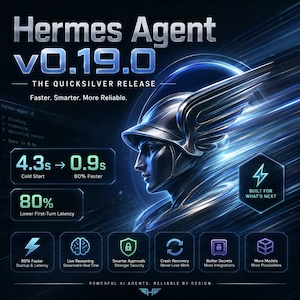
You receive Your AI Assistant Just Got 80% Faster: Inside Hermes Agent v0.19.0 “The Quicksilver Release” and You wait four seconds. Then another. Then you wonder if your AI forgot you exist.
Those days died on July 20, 2026.
Hermes Agent v0.19.0—codenamed “The Quicksilver Release”—landed that morning. It doesn’t just tweak performance. It rewrites the contract between you and your machine. Cold starts collapsed from 4.3 seconds to 0.9. First-turn latency dropped 80% across every platform. And that’s merely the opening act.
The Community Behind Quicksilver
This is the largest contributor window in Hermes history. Period.
450 community contributors poured their expertise into this release. The stats tell the story: 2,245 commits landed across roughly 1,065 merged pull requests. Developers touched 2,465 files, injecting approximately 300,000 new lines of code while carefully removing 36,000 deletions. The window slammed shut on about 3,300 reported issues. No prior release drew this much firepower. No prior release delivered this comprehensively.
80% Faster. 0.9 Seconds. Finally.
Remember the 4.3-second cold-start initialization? That agonizing wait while your first message stalled before even touching the model?
Those seconds evaporated.
The engineering team stripped blocking work from startup entirely. They stopped probing Ollama for non-Ollama providers—finally. Discord capability detection now caches to disk with a 24-hour TTL, and refreshed checks moved to background threads where they belong. Result: your first token arrives in roughly 0.9 seconds. An 80% cut across every platform.
Reasoning models transformed too. No more staring at a 30-second spinner while chain-of-thought processes locked away in silence. Now they stream their reasoning live by default. The response box paints per token, not per sluggish line. You watch the thinking happen in real time.
The desktop application absorbed more than 20 performance-focused pull requests. Streaming markdown now consumes roughly 14 times less CPU thanks to incremental block lexing. Giant diffs no longer freeze the review pane—it’s fully virtualized now. Switching sessions stopped thrashing your layout completely. Sidebar and tool-row re-renders vanished during streaming. Profile backends pre-warm when you hover, anticipating your needs, and boot-hidden panes mount at idle instead of blocking your cold path.
The TUI received identical treatment. Transcript blocks appear as they stream through incremental markdown rendering. You read while it writes.
Intelligence That Protects Itself
Tired of approving every flagged command manually? Exhausted by the interruption?
Smart approvals are now the default. When Hermes wants to run something sensitive, a separate language-model reviewer assesses it independently. Each verdict ties to that exact command signature, so later matches still trigger fresh reviews. You’re not stuck clicking “yes” endlessly for similar operations.
You wield new power over denials. Define explicit deny rules that block specific commands even in yolo mode. Type slash deny followed by a reason, and the agent learns. It remembers the refusal context. It course-corrects for next time.
Security got serious elsewhere too. The new pluggable SecretSource interface consolidated eleven competing community pull requests into one orchestrated design. Hermes now fetches secrets from Bitwarden and 1Password using op references at load time, alongside traditional environment files and dot-files. It handles multiple vaults simultaneously, detects conflicts between overlapping entries ruthlessly, exposes per-variable provenance so you know exactly where every credential originated, and accepts future vault providers as plugins without core rewrites.
Vertex credentials now stay strictly scoped away from subprocess environments. Media vision and image generation local file reads route through a shared credential-read guard. Every aiohttp server received a webhook body size cap sweep. Telegram transport errors now redact bot tokens automatically. Fireworks token prefixes get redacted too. Six pull requests hardened browser media and dot env handling against emerging threats.
Routing & Reliability That Survives Crashes
What happens when your gateway crashes mid-delegation? Previously, you lost the task, the context, and your sanity.
Not anymore.
The delegate task dispatch system now returns live transcript files for each sub-agent. Read them with tail minus f from the moment workers launch. A background delegation completion system survives gateway restarts mid-run—an ownership-checked ledger stores results and redelivers them after any process restart.
Similarly, a delivery-obligation ledger protects final responses. If the gateway crashes between generating an answer and confirming platform delivery, the response lives safely in a durable sqlite table. Automatic redelivery triggers on next boot. This closes a priority-one silent-loss window that previously haunted Telegram, Discord, Slack, and every other channel.
Profile-based message routing landed too. A single multiplexed gateway sharing one bot token now routes specific guilds, channels, or threads to fully isolated profiles. Each profile carries its own configuration, skills, memory, and secrets. One misconfigured profile can no longer crater your entire gateway operation.
More Models, More Control
Fireworks AI and DeepInfra graduated to first-class providers. You get cost estimation and cached price columns for both, making budget forecasting actually possible.
The model catalog expanded aggressively. GPT-5.6 arrived across Sol, Terra, Luna, and Pro variants. Grok-4.5 hit general availability. MoonshotAI’s kimi-k3 replaced kimi-k2.x on the Nous Portal and OpenRouter. Claude-fable-5 and claude-sonnet-5 joined the curated list. Tencent’s hy3 went GA.
Reasoning effort controls now offer max and ultra tiers selectable on every surface. Configuration supports per-model overrides and per-slot mixture-of-agents preset controls. The default silent model now answers to GLM-5.2.
Subscription management finally escaped the browser. Inside your terminal, slash subscription and slash topup commands display current plans, usage metrics, upgrade and downgrade previews, scheduled-change banners, and undo options. The desktop app mirrors this with a dedicated billing settings tab.
Session export multiplied its vocabulary. Choose Markdown, Quarto, HTML, prompt-only extracts, or Hugging-Face-ready trace formats. Filter by age, workspace, or platform. Redact secrets automatically before sharing. Compaction lineage stitches everything into one logical export you can actually trace.
The Bottom Line
The Quicksilver Release doesn’t ask you to wait. It doesn’t ask you to trust blindly. It hands you 450 contributors’ worth of speed, security, and reliability—then gets out of your way.
Stop losing responses to crashes. Stop waiting for spinners. Stop managing secrets manually.
Update today. Your 0.9-second future is waiting.