Discover how Hermes Agent’s new Mixture of Agents system combines multiple frontier AI models into a single collaborative workflow that can deliver stronger reasoning, better reliability, and more flexible AI assistance.
You know the frustration. You open Claude for deep reasoning, switch to GPT for coding, then hop over to DeepSeek for technical analysis. Three tabs. Three subscriptions. Three different conversations that never quite talk to each other. What if they could?
What MoA 2.0 Actually Does
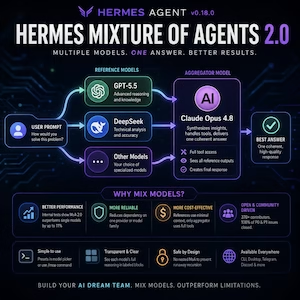
On July 1, 2026, Nous Research dropped Hermes Mixture of Agents 2.0 as part of Hermes Agent v0.18.0, codenamed “The Judgment Release.” Here’s how it works. You pick multiple “reference models”—say GPT-5.5 and DeepSeek—to independently chew on your prompt. Then one “aggregator” model, perhaps Claude Opus 4.8, synthesizes their outputs into a single coherent answer and handles any tool calls. Think of it as assembling your own dream team of AI specialists for every query.
The results? Nous ran internal tests on their upcoming HermesBench benchmark. Their default preset—GPT-5.5 and DeepSeek as references, Claude Opus 4.8 aggregating—scored 0.8202. Claude alone managed 0.7607. GPT-5.5 hit 0.7412. That’s roughly 8% above Opus and 11% above GPT-5.5 working solo. Sure, the public leaderboard and full methodology are still cooking. But the numbers suggest something serious: collaboration beats isolation.
Using It Is Dead Simple
Named presets show up as “virtual models” right in your model picker, alongside Claude, GPT, and Grok. Whether you’re on CLI, desktop, or messaging through Telegram and Discord, they’re just… there. Need a quick ensemble call without changing your default? Type `/moa [your prompt]`. It runs the mixture, then snaps back to your regular model. No fuss.
The Engineering That Makes It Work
Teknium, Nous’s chief engineer, and his team made some clever choices. Prompt caching sticks reference outputs onto the end of your latest turn so context flows naturally. They banned nested MoA to prevent runaway recursive mixing—imagine models endlessly debating each other until your credits evaporate. Each reference model’s full reasoning appears in labeled blocks so you see exactly who thought what. And here’s the cost hack: only the aggregator gets full tool access. References work with a stripped-down conversation—no system prompts, no tool history. Cheaper. Faster. Fewer provider refusals.
The team’s already testing open-source reference combinations to hit “Opus-level output at much lower cost.”
Why Now?
Timing matters. On June 12, a U.S. export-control directive forced Anthropic to suspend Fable 5 and Mythos 5 worldwide. Nineteen days of silence. Nous is positioning MoA 2.0 as insurance against exactly this kind of disruption—no more betting everything on a single, access-restricted frontier model.
The Community Behind It
This isn’t corporate vaporware. Hermes Agent v0.18.0 closed 100% of open P0 and P1 issues—about 700 highest-priority items—plus roughly 1,950 total issues and PRs. More than 370 community contributors made it happen.
You don’t need to wait for permission to build something better. Grab the open-source framework. Mix your models. Watch them outperform the monoliths.