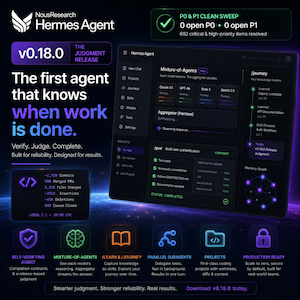
What if your AI stopped guessing and actually knew when the work was done? Not when it ran out of tokens. Not when it got tired of generating text. But when the task actually met your standards. On July 1, 2026, at precisely 20:08 UTC, NousResearch released Hermes Agent v0.18.0 to answer that question definitively.
Authored by teknium1 and shaped by over 370 community contributors, this isn’t another incremental update adding shiny distractions that gather dust. They call it “The Judgment Release,” and the name cuts straight to the heart of the matter. It marks the precise moment your agent started thinking about the quality of its thinking, not just the speed of its output.
The Zero-Bug Milestone
The headline achievement commands your attention immediately: a complete P0 and P1 clean sweep across the entire repository. If you manage software, you know these labels aren’t vanity metrics. P0 means catastrophe. P1 means crucial brokenness. The team resolved 100% of these critical and high-priority issues and pull requests. That means 3 critical P0 issues plus 8 related PRs, wiped from existence. That means 493 high-priority P1 issues plus 188 related PRs, handled completely. Roughly 692 highest-priority items total, finished and closed with prejudice.
At the precise moment the sweep completed, the open P0 and P1 count hit zero across the repo for the first time. Special credit belongs to contributor kshitijk4poor for the bulk of this heavy lifting, including the final interrupt-protected-compression sibling-fork bug fix that closed both #56391 and #56416. The team’s public intention is unambiguous: they aim to keep P0 and P1 at zero going forward. That means no more critical bugs lurking in the backlog, no more anxiety about hidden crash triggers waiting to ambush your workflow at 2 AM.
Since v0.17.0, the sheer scale of judgment shows in the commit history like rings on a tree. Approximately 1,720 commits flowed into this release. 998 merged pull requests made it through careful human review. 2,215 files changed hands. Roughly 251,000 insertions and 41,000 deletions reshaped the codebase into something tighter and more reliable. 949 issues closed for good, never to confuse another user. All of this work is permanently stamped with tag v2026.7.1, timestamped at 20:08 UTC on release day.
Judgment in Action
Mixture-of-Agents graduates from experimental feature to first-class selectable model. Each named MoA preset now appears as a distinct model option under a dedicated moa provider, sitting right alongside Claude, GPT, and Grok in every model picker throughout the interface. You pick a council exactly like any other single model, and Hermes routes through that ensemble automatically.
The magic happens in the transparency. During MoA execution, each reference model’s full reasoning renders as its own labeled block in your chat. You read exactly what each model thought, seeing their individual reasoning processes unfold, before the aggregator synthesizes its final answer. Then the aggregator’s response streams live to you word by word instead of dumping everything at once behind a loading spinner. You witness the thinking, not just the polished conclusion.
The agent now verifies its own work instead of merely asserting success and hoping you won’t bother checking. A coding verification evidence ledger records canonical project checks for later inspection. More importantly, the /goal command gained completion contracts. You state exactly what “done” looks like in plain language, defining your acceptance criteria upfront without ambiguity.The standing-goal loop then judges completion against actual evidence from your codebase and test results, never against the model’s own optimistic say-so. It knows when to stop because it rigorously checks the proof against your contract.
Memory You Own
Knowledge becomes truly yours with the /learn command. Describe anything you want captured—a directory full of legacy code, a URL documenting a complex API process, or a workflow you just walked through step by step in a demo. Run /learn and Hermes distills it into a reusable skill that automatically honors your CONTRIBUTING.md standards without you micromanaging the format or cleaning up afterward. Your institutional knowledge now persists correctly the first time.
Then there’s /journey. It shows a playable timeline of everything Hermes has learned about you over time, organized chronologically like a version history you fully control. Memories and skills list in order, and you retain absolute control to edit or delete any entry that seems wrong or outdated. The desktop app adds a memory graph, a top-down playable radial timeline that makes the agent’s knowledge visible and navigable like a subway map instead of remaining a frustrating black box of hidden weights you cannot inspect.
Your productivity multiplies dramatically because delegate_task can now fan out multiple background subagents that all run asynchronously. Your chat never blocks while they work in the background. Research five competitors in parallel while you eat lunch. Audit three modules simultaneously for security issues. Draft documentation while tests and linters run elsewhere against different codebases. Carry on your conversation while a small fleet works behind the scenes. When every subagent finishes, their results return to you as one consolidated turn, organized and ready for your review without painful context switching between tabs.
The desktop app itself grew serious muscles with first-class coding Projects. A per-profile sidebar houses your codebases for quick access and immediate context when switching contexts. A dedicated coding rail keeps tools immediately accessible. A review pane shows your diffs clearly without leaving the environment. Git worktree management keeps experimental branches organized without cluttering your main workspace with tangled checkouts. Agent-facing project tools sit structured under a proper project-to-repo-to-lane model that matches how you actually think about software architecture when you’re deep in the flow state.
Production Ready
Infrastructure matters when you’re building something real that others depend upon daily. The gateway now goes dormant when idle, saving resources and money, and quiesces cleanly before restart, migration, or auto-update without dropping your in-flight conversations mid-thought. Scale-to-zero plus drain coordination makes running Hermes for a team or as a hosted service production-grade, not merely experimental hobby infrastructure that panics under load or loses user data during deployments.
Self-improvement finally respects your budget constraints. The post-turn review fork routes to an auxiliary model that digests context intelligently instead of replaying the whole conversation from scratch. It adapts its cadence based on what actually happened in the session. That learn-from-what-happened loop costs a fraction of what it used to, putting continuous autonomous improvement within reach of smaller teams with limited inference budgets.
Long-form prompting gets the respect it deserves after years of textarea frustration. The /prompt command opens your $EDITOR so you can hand-write long multi-line prompts in real markdown with proper formatting, bullet points, and code blocks instead of fighting a cramped one-line input box that breaks your creative flow. Google Vertex AI arrives as a first-class provider for Gemini models, auto-minting and refreshing short-lived OAuth2 tokens from service-account JSON automatically behind the scenes. Your requests never expire mid-session, and you never need to manage a static API key again or worry about credential rotation interrupting your work.
Security hardening runs deep and specific, not vague promises on a press release. The MCP-config persistence attack surface is locked down completely. Cron base_url overrides that could exfiltrate provider credentials are blocked entirely. A non-reusable sentinel guards prefix secrets in file reads. Slack app-level tokens get redacted automatically from logs before they can leak. A browser cloud-metadata floor protects every backend. An aiohttp CVE floor secures lazy messaging paths across the entire system against known vulnerabilities.
This update doesn’t merely add features to a long list that grows stale over time. It fundamentally changes the contract between you and your tools. Hermes Agent v0.18.0 proves daily that an AI can think clearly, remember honestly, verify its own work, admit when evidence is missing, and finish completely without dragging you through endless iterations. Download it today and experience an agent that finally knows when its work is actually done.